Photobiomodulation has a meaningful research base for plantar heel pain. Several reviews and trials report short-term pain or function benefits when light is used alongside usual care; the newer analysis found a clearer effect on heel tenderness than on every pain and function measure. That makes the useful buying question which recovery outcome you want to support and how a device will fit your broader plan.
Does Red Light Therapy Help Plantar Fasciitis?
There is real clinical evidence — but it is mixed.
The strongest interpretation of the research today is that photobiomodulation may help some aspects of plantar fasciitis symptoms and may be useful as an adjunct to conventional care, but it should not be treated as a guaranteed cure or primary stand-alone treatment.
What Earlier Reviews Found
A 2022 systematic review and meta-analysis examined randomized trials involving lower-extremity tendinopathy and plantar fasciitis.
Across the included studies, low-level laser therapy was associated with improvements in pain and disability in the short and medium term.
A 2023 systematic review focused specifically on plantar fasciitis and included 19 randomized controlled trials involving 1,089 participants.
That review found that PBMT improved short-term pain intensity when used alone or with exercise.
However, evidence for improvements in disability and function was less certain.
Those findings suggested that light-based therapy could have a meaningful role in plantar fasciitis care.
But newer evidence adds important context.
What the 2024 Randomized Trial Found
A 2024 randomized controlled trial compared usual plantar fasciitis care with usual care plus photobiomodulation.
Participants receiving PBMT underwent nine treatments over three weeks using a standardized clinical protocol.
Pain improved more in the PBMT groups during the first three weeks than in the usual-care-only group.
Foot and ankle function also improved more in the PBMT groups.
Importantly, PBMT was used in addition to usual care, not instead of it.
The study therefore supports the idea that PBMT may be useful as an adjunct to plantar fasciitis management.
It does not show that a light device by itself resolves the underlying condition.
What the Latest 2026 Meta-Analysis Found
A 2026 meta-analysis provides a more cautious view.
Researchers examined clinical trials in a 2026 systematic review with plantar fasciitis.
Laser-based therapies produced a statistically significant improvement in heel tenderness.
However, the analysis did not find consistent significant improvements in:
- Overall pain
- Foot function
- Plantar fascia thickness
Pain and functional outcomes also varied substantially between studies.
The authors concluded that laser therapy may have value as a therapeutic adjunct, but should not be considered a primary intervention for plantar fasciitis.
Why Might Photobiomodulation Be Relevant to Plantar Fasciitis?
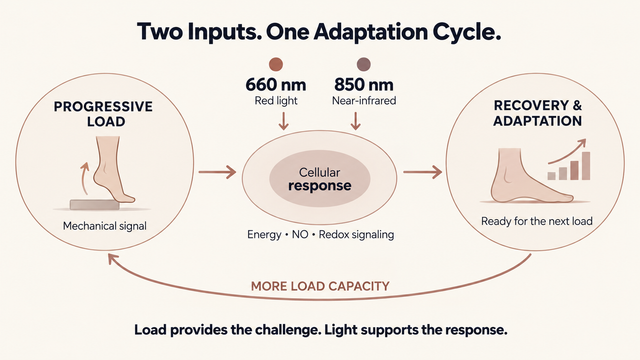
Plantar fasciitis is strongly influenced by mechanical loading.
Every time you stand, walk, or run, the plantar fascia experiences stress.
Recovery therefore involves more than simply changing how the heel feels for a few minutes.
Photobiomodulation is being studied for its potential influence on biological processes involved in tissue recovery, including:
- Cellular energy metabolism
- Local inflammatory signaling
- Circulatory responses
- Oxidative stress
- Pain modulation
These mechanisms provide a plausible basis for PBMT research in musculoskeletal conditions.
For someone with plantar fasciitis, the practical goal is to combine recovery modalities with strategies that address the mechanical side of the problem.
To put that distinction into a practical plan, see how progressive loading and red-light-supported recovery work together for plantar fasciitis: loading supplies the mechanical challenge, while light fits into the recovery interval between challenges.
Where Should Red Light Be Used for Plantar Fasciitis?
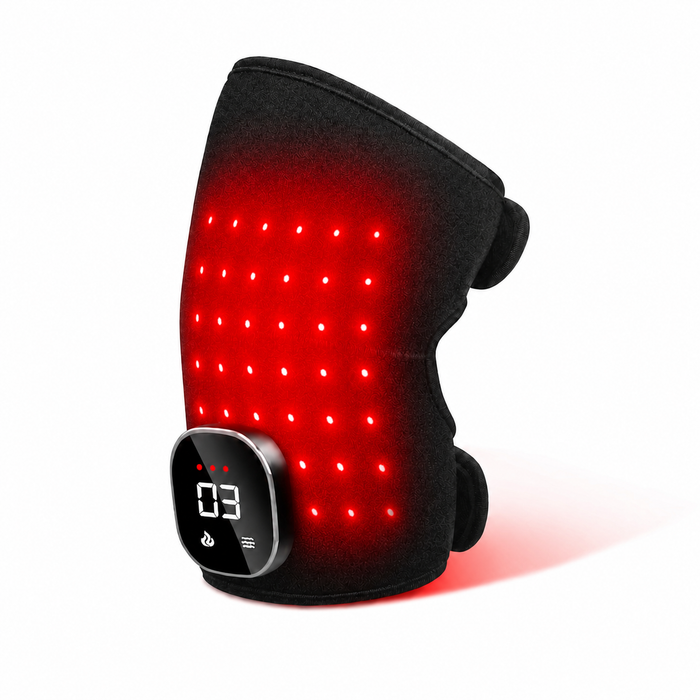
For plantar heel discomfort, align the light with the underside of the heel and the heel-to-arch region. A panel requires the sole to face it; a foot-shaped wearable keeps the emitting surface around the area while you sit.
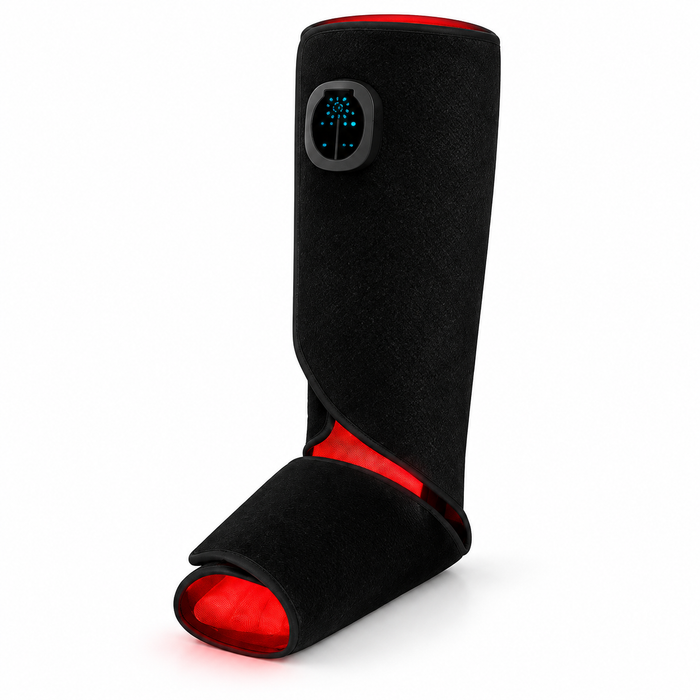
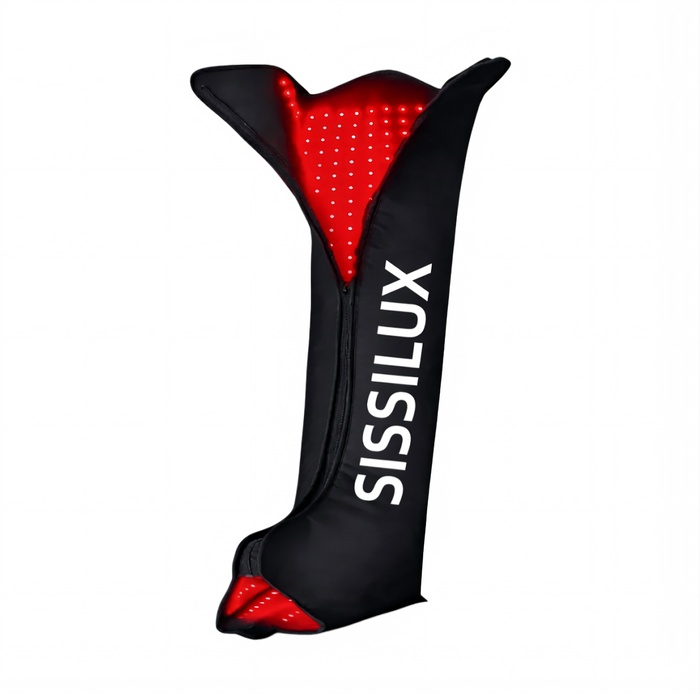
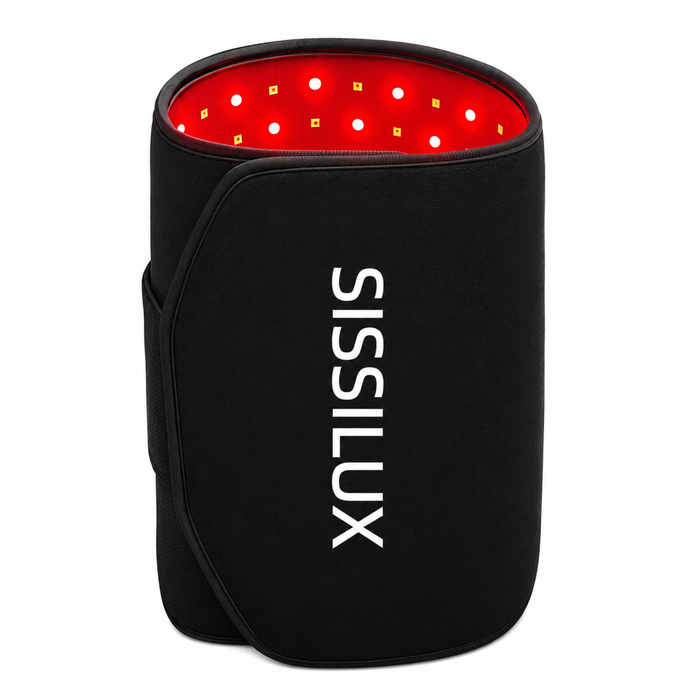
SissWrap™ Foot combines 660 nm red and 850 nm near-infrared light in a cordless format around the sole, heel and ankle. It is worth considering when that close, repeatable setup makes your foot-recovery routine easier. See heel-and-sole positioning or the device-format comparison for the next practical decision.
What Else Should You Do for Plantar Fasciitis?
Plantar fasciitis usually should not be approached with one treatment alone.
A broader recovery plan may include:
- Plantar fascia-specific stretching
- Calf stretching
- Progressive foot and calf strengthening
- Appropriate footwear
- Temporary activity modification
- Gradual return to running or higher-impact exercise
- Orthotics when clinically indicated
- Physical therapy when appropriate
- Load management
Red light therapy can sit alongside those strategies.
It should not replace them.
If the same activities continue overloading the plantar fascia beyond what it can tolerate, no passive recovery modality is likely to solve the entire problem by itself.
Ready to turn the research into a device choice? Our plantar fasciitis red light therapy and SissWrap Foot guide brings together the study findings, close-contact design and real sole-and-heel placement images.
Add light where it serves your heel-pain routine
Photobiomodulation has shown benefits for short-term heel pain in several trials, including a 2024 study adding it to usual care. The 2026 analysis found a clearer benefit for heel tenderness than for overall pain or function. Choose the outcome you want to track—first-step discomfort, tenderness or ordinary walking—and keep stretching, supportive footwear and load management in the plan.
For the next step, use the heel-and-sole setup guide for placement, or the plantar-fasciitis device comparison to choose equipment.
For targeted home use, a device that keeps red and near-infrared light positioned around the heel and sole may make treatment easier to repeat.
Explore the Sissilux Red & Near-Infrared Light Therapy Wrap for Feet & Ankles →
References
- Naterstad IF, et al. Efficacy of low-level laser therapy in patients with lower extremity tendinopathy or plantar fasciitis: systematic review and meta-analysis of randomised controlled trials. BMJ Open. 2022.
- Ferlito JV, et al. Effects of photobiomodulation therapy on the management of pain intensity and disability in plantar fasciitis: systematic review and meta-analysis. Lasers in Medical Science. 2023.
- Ketz AK, et al. Photobiomodulation Therapy Plus Usual Care Is Better than Usual Care Alone for Plantar Fasciitis: A Randomized Controlled Trial. International Journal of Sports Physical Therapy. 2024.
- Ortiz-Romero M, et al. Effect of Local Laser Therapy on Plantar Fasciitis: A Meta-Analysis. Journal of Clinical Medicine. 2026.